 Phuket Boat Tours
What to Bring on a Phuket Boat Tour
Working out what to bring on a Phuket boat tour is mostly a question of what the operator already hands you at the pier. Life jackets and snorkel gear are standard across the Phi Phi routes compared here, drinking water is on all six, and one tour even hands out motion-sickness medicine before departure. What is left on your own list is short but specific: sun protection, a dry bag, cash for the park fee, and whatever gets you through open water without spending the day feeling ill. This guide sets out the exact provided-versus-bring split tour by tour, a packing checklist you can run through the night before, what to leave at the hotel entirely, and the seasickness advice none of the operator listings spell out in full.
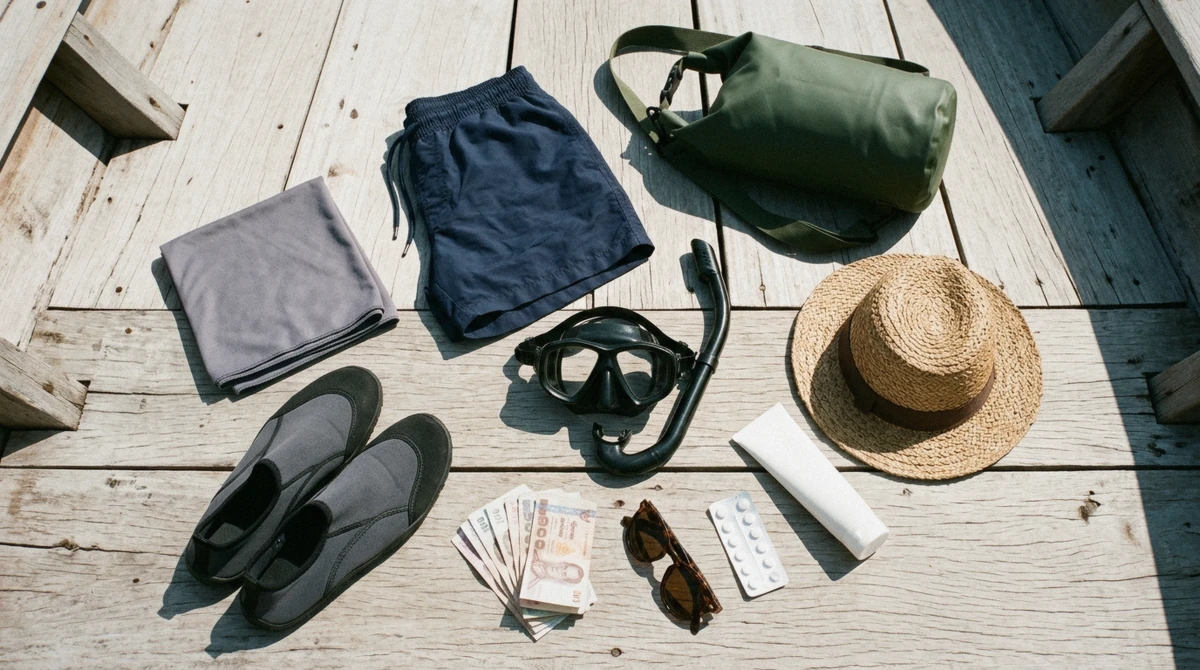
Quick answer Life jacket and water are covered; sun protection, a dry bag and cash are on you
Tours compared here already provide the life jacket, snorkel gear on the Phi Phi routes, and drinking water; what you actually need to bring is sun protection, a dry bag, cash for the park fee and, if you are prone to it, something for seasickness. Fins, water shoes and the photo boat at Pileh Lagoon are sold on the day, not included.
Key takeaways
- See what each Phuket boat tour includes before deciding what to pack yourself
- Fins are 100 THB per pair on the Phi Phi speedboat; water shoes and beach chairs are also sold on the day
- The power catamaran hands out a fresh snorkel mouthpiece per guest and asks specifically for biodegradable sunscreen
- The 400 THB Mu Ko Phi Phi park fee is cash only at check-in on two of the six tours
- Water shoes beat sandals at every rocky entry point on the Phi Phi circuit
- Browse tours with gear included if you'd rather not rent fins or a wetsuit on the day
What to Wear
Swimwear and base layer
Swimwear under quick-dry clothing is the standard base for every tour compared here. A rash guard over swimwear covers hours of sun on an open deck better than sunscreen alone, and it dries faster than a cotton shirt if you get splashed on the open Phi Phi crossing.
Sun protection
Sunscreen is the baseline, but a long-sleeve rash guard or a light long-sleeve shirt does more for a full day on the water than reapplication alone. The power catamaran's listing specifically asks guests to use biodegradable sunscreen; treat that as the standard across all six tours rather than a rule unique to one, since the same reef water is shared by every operator's snorkel stops.
Outer layer
None of the six tours require or recommend a wetsuit; the Andaman Sea around Phuket runs warm year-round and every listing treats swimwear as sufficient. A light windbreaker is worth packing for the open-deck stretch of the Phi Phi crossing, where wind chill at speed is real even in warm air.
Footwear
Water shoes are the safe default for the rocky entries at Pileh Lagoon and the Phi Phi Leh snorkel stop; sandals with a secured strap are fine for lounging on deck but not for wading in. Barefoot is workable on the soft sand at Khai Island and Naka Island but not on the rockier stretches. Flip-flops and unsecured sandals are the one footwear choice to actively avoid: they come off in current and offer no grip on a wet boarding step.
| Color | Good? | Why |
|---|---|---|
| White | Mixed | Reflects heat well in direct sun, but shows dirt and sunscreen streaks fast on a boat deck |
| Black | Usually avoid | Absorbs heat under direct sun for hours; fine for the after-dark stretch of the sunset cruise |
| Bright colours | Good | Easier for crew to spot you at a distance during a swim or snorkel stop |
| Earth tones | Neutral | No real advantage on a boat tour; mainly a wildlife-viewing consideration on land-based tours |
| Camouflage pattern | Avoid | Civilian camouflage-pattern clothing is restricted in Thailand; wear something else |
| Cotton fabric | Avoid | Stays wet and cold once splashed and takes hours to dry on deck |
| Quick-dry synthetic | Good | Dries within an hour of a swim stop instead of staying damp for the rest of the day |
What to Bring
A short kit covers nearly everything that actually comes up across the six tours compared here.
- Reef-safe sunscreen, reapply before the day, not mid-tour
- A dry bag, keeps a phone dry on the open Phi Phi crossing
- Cash in small notes, tips and the park fee take no card
- A refillable water bottle, hours of sun with limited shade
- A full change of clothes, you will get wet at some point
- Motion-sickness tablets, taken about an hour before departure
- A light windbreaker, wind chill is real once the boat is moving
- A hat with a chin strap, loses in the wind otherwise
- A waterproof phone case or pouch, for the shots the Phi Phi stops are known for
- A strap for glasses, useful wherever a snorkel mask sits over the frames
What Phuket Boat Tours Provide (So You Don't Overpack)
Inclusions vary tour to tour, and the differences are exactly where you can safely leave gear at the hotel.
| Item | Usually provided | Bring your own | Notes |
|---|---|---|---|
| Life jacket | Yes, all six tours | No | Fitted and mandatory under Thai Marine Department rules |
| Snorkel mask and snorkel | Yes, on the Phi Phi routes | No | The power catamaran fits a new mouthpiece per guest |
| Fins | No | Rent on the day | 100 THB per pair on the Phi Phi speedboat |
| Towels | Only on the sunset cruise | Bring your own on the other five | Confirmed on the James Bond Island listing |
| Drinking water | Yes, all six tours | No | Free-flow on most; soft drinks vary by tour |
| Motion-sickness medicine | Yes, one tour | Bring your own elsewhere | Included on the Phi Phi speedboat; recommended but not supplied on the power catamaran |
| Clear kayak or paddleboard | One tour only | Not applicable | Included on the Phi Phi and Maya Bay day trip |
| Water shoes | No | Bring or buy locally | Sold at some stops but not stocked as a rental |
| Beach chairs | No | Rent on the day | Available for hire at several stops, not included in any fare |
| Long-tail photo boat at Pileh Lagoon | No | Optional paid extra | Several reviewers say it's worth the cost for the lagoon shot |
| Sunscreen | No | Bring your own | The power catamaran asks specifically for a biodegradable formula |
| Wetsuit | Not offered | Not needed | No tour compared here uses or recommends one; water is warm year-round |
Seasickness: What Actually Helps
Who should think about it seriously
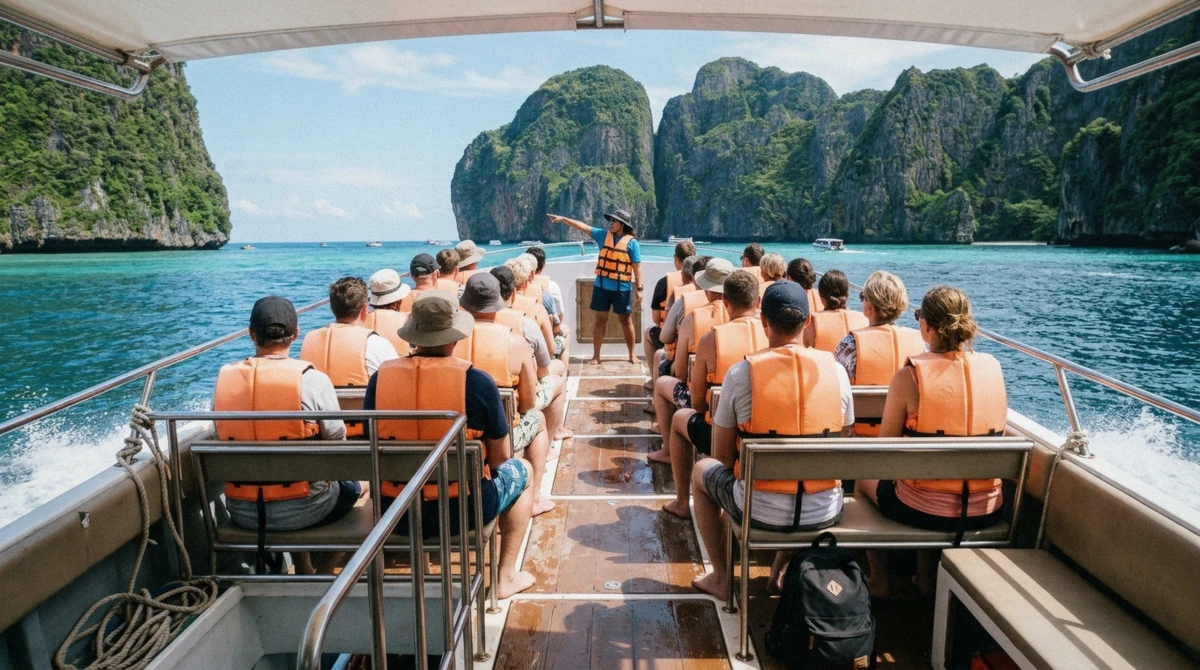
The Phi Phi crossing runs about an hour over open Andaman Sea; the Phang Nga Bay crossing is 30 to 45 minutes through water sheltered by its own islands and is the calmer option if motion sickness is a known problem for you. One operator's own listing states the June to October ride as very bumpy, and that same tour is the only one of the six that hands out motion-sickness medicine before departure. Another lists it as a recommendation rather than a supply, which is a fair signal that the crossing is rough enough to plan around even outside the wettest months.
What to actually do about it
Take any motion-sickness remedy roughly an hour before departure, not once you already feel unwell; by the time symptoms start, an oral tablet is working against a head start it cannot make up. Confirm dosage with a pharmacist rather than guessing, particularly for a child or anyone on other medication. On the boat itself, sit toward the centre and lower rather than the bow or the upper deck, where motion is most exaggerated, and keep your eyes on the horizon rather than a phone screen.
Fresh air on deck beats sitting inside a cabin if the boat has one. None of this is medical instruction, only practical positioning and timing; anyone with a history of severe motion sickness should talk to a doctor before booking a full day on open water.
What NOT to Wear or Bring
Sourced from the operators' own restrictions, not generic packing advice. Most of these rules exist for a practical reason rather than an arbitrary one: a lost drone means a search-and-rescue call nobody wants to make on someone else's day, and a stroller wedged into a walkway on a moving boat is a genuine trip hazard for every other passenger, not just an inconvenience.
- Drones, explicitly banned on two of the six listings
- Smoking materials, banned on board on at least one listing
- Camouflage-pattern clothing, restricted for civilian wear in Thailand generally
- Weapons, sharp objects, glass containers or explosives, standard exclusions across the listings
- Strollers or prams, one operator states these are not permitted on board
- Unaccompanied minors or pets, excluded on at least one listing
- Flip-flops or unsecured sandals for the activity itself, they come off in current and offer no grip on a wet step
- Cotton clothing as your main layer, it stays wet and cold for the rest of the day once splashed
- Jewellery you would mind losing, a rocking boat and open water are a bad combination for anything that can slip off
Packing by Season in Phuket
November through April
The dry season and the calmest water of the year. A rash guard, sunscreen and a hat cover most of the day; a light layer for the evening is worth packing on the sunset cruise, when the temperature drops noticeably once the sun is down.
May and June
The south-west monsoon is starting. Pack the same warm-weather kit as the dry season, plus a light windbreaker for occasional squalls; rain showers pass quickly and rarely change the plan.
July and August
Steady monsoon rainfall and a genuinely bumpier ride on the open Phi Phi crossing. A dry bag stops being optional here, and motion-sickness tablets are worth packing even if you don't usually need them.
September and October
The wettest stretch of the year, with monthly rainfall normals of 361 millimetres in September and 320 millimetres in October. Pack for the possibility of a shortened or rescheduled day; our best time for Phuket boat trips guide covers the full seasonal picture if you have flexibility on dates.
Bringing Kids: A Short Note
None of the six tours specify child-size life jacket sizing on their listings, so confirm it directly with the operator if you're travelling with a small child; snorkel gear and drinking water are provided the same as for adults. Attention span, motion sensitivity and the sun-exposure kit above matter more for a child than an adult over a full day on the water, and the seasickness advice in the section above applies just as much to a child, with dosage confirmed by a pharmacist rather than guessed. Our dedicated Phuket boat tour with kids guide covers age limits, readiness and a kids-specific packing list in full; this section stays a pointer rather than repeating that depth.
Packing FAQ
What sunscreen is allowed on these boats?
Bring reef-safe sunscreen. One operator asks specifically for biodegradable sunscreen, and every Phi Phi and Phang Nga stop sits inside a national park where reef damage is the reason the rules exist at all. Oxybenzone and octinoxate formulas are the ones to leave behind. Nobody searches your bag, so this one is on you.
Do I need water shoes for a Phuket boat tour?
They help at the rocky entries at Pileh Lagoon and the Phi Phi Leh snorkel stop. Barefoot works fine on the soft sand at Khai Island and Naka Island, but not on the rockier stretches.
Can I wear glasses or a prescription snorkel mask?
None of the six listings mention a prescription mask option; bring a strap for your existing glasses if you plan to wear them under a standard mask, or check with the operator about a prescription lens in advance.
Is a wetsuit necessary?
No. Andaman Sea water around Phuket stays warm year-round and none of the six tours require or recommend one.
What should I not bring on a Phuket boat tour?
Drones and camouflage-pattern clothing are the two most commonly missed restrictions; strollers, unaccompanied minors and pets are excluded on at least one listing. See the full list above.
Does the tour provide snorkel gear and a life jacket?
Yes, on all six tours for the life jacket, and on the Phi Phi routes for snorkel gear; the power catamaran fits a fresh mouthpiece per guest.
Will my phone get wet on the boat?
It can, particularly on the open Phi Phi crossing where spray is routine. A dry bag is the one item worth buying before the trip if you don't already own one.
Do I need seasickness tablets?
Worth packing if you have any history of motion sickness, especially between July and October when the Phi Phi crossing gets noticeably rougher. One tour includes the medicine; the rest do not.
Can I wear jeans on a boat tour?
No. Jeans stay wet and heavy once splashed, restrict movement getting in and out of the water, and take hours to dry on deck. Quick-dry shorts or swimwear under light clothing work better.
Can I wear shorts on a Phuket boat tour?
Yes, quick-dry shorts are the standard choice across all six tours. There is no dress-code restriction on any of the stops covered here.